
Executive AI Roles
What are they and paths to get there

5 Surprising Truths About Landing a C-Suite Job in Data & AI
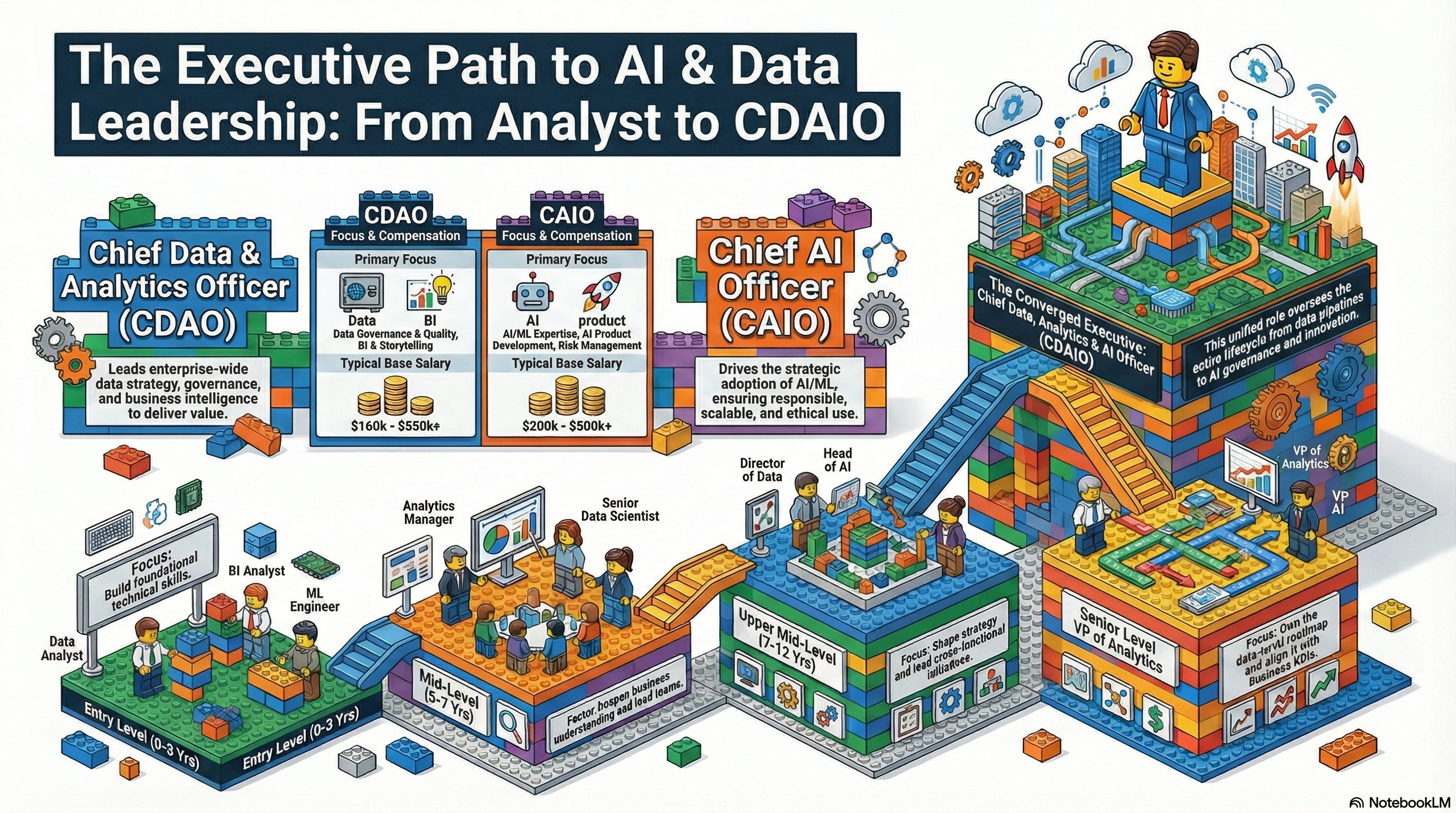
The ambition to reach the highest levels of leadership in data and artificial intelligence has never been stronger and maybe more confusing. As organizations find data at the center of their strategy, following challenged AI implementations, executive roles such as Chief Data & Analytics Officer (CDAO) and Chief AI Officer (CAIO) have become some of the most influential—and competitive—positions in modern business.
Many highly capable technical leaders view the C-suite as the natural culmination of their careers. In practice, however, the path to these roles is shaped by realities that extend well beyond technical excellence. The skills that elevate someone to senior management are not the same skills that earn credibility at the executive table.
Below are five truths that consistently surprise aspiring data and AI executives—and that matter far more than most people expect.
1. The C-Suite Is Reshaping Itself: Roles Are Both Splitting and Merging
The first reality is that the data and AI C-suite is not static. It is actively evolving, shaped by two forces that appear contradictory but coexist in practice.
On one side is specialization. As AI systems grow more complex and regulatory scrutiny increases, organizations are carving out focused leadership roles. The rise of the Chief AI Officer (CAIO) reflects the need for dedicated ownership of AI strategy and deployment. Similarly, the emergence of the Chief Trust Officer (CTrO) underscores the growing importance of data protection, ethics, and digital trust.
At the same time, many mature organizations are moving in the opposite direction—toward convergence. In these environments, companies are consolidating responsibility under a single executive, often titled Chief Data, Analytics, and AI Officer (CDAIO). The goal is end-to-end accountability: from data foundations and governance through analytics, AI, and measurable business outcomes. This may also be a strategy to reduce budget; hire a team in a person. It is something to keep an eye out for.
For aspiring leaders, the implication is clear. You are not preparing for a single, fixed role. You are preparing for an executive landscape that rewards both depth and integration. Adaptability is not optional—it is foundational.
2. The Paycheck Is Bigger—and More Complicated—Than It Looks
Compensation is often cited as a motivator for pursuing the C-suite, but the reality is more nuanced than headline numbers suggest.
While broad U.S. averages for CDAO compensation are often quoted around $150K, those figures obscure significant variation. In small to mid-sized organizations, base salaries commonly range from $160K to $350K. In large enterprises, base compensation frequently climbs into the $250K–$550K+ range, with bonuses and equity often eclipsing base pay. These are as researched would love to have recruiters weigh in on what is current by industry and geography to get a wider and current perspective.
Chief AI Officer roles tend to command an even higher premium. Average U.S. base salaries typically fall between $350K and $380K, with total compensation packages—once incentives and equity are included—ranging from $400K to well over $2M in top-tier environments.
The key point is this: executive compensation is less about title and more about scope, risk, and measurable impact. Pay increases as accountability for business outcomes increases. Also, there seemed to be a measurable range by industry and geography. AI Firms can be a whole different stratosphere for experienced professionals.
3. To Get the Job, You Have to Stop Thinking Like a Coder and Start Thinking Like a CEO
A strong technical foundation is table stakes. It is not what differentiates executive candidates.
The transition to the C-suite requires a deliberate shift—from execution to enterprise leadership. Successful data and AI executives are fluent in business outcomes, not just models, platforms, or architectures.
The capabilities that matter most at this level are fundamentally non-technical:
Strategic Vision: Connecting data and AI initiatives directly to enterprise priorities.
Executive Communication: Translating technical potential into business narratives that resonate with non-technical peers.
Change Leadership: Driving cultural adoption of data-driven decision-making across the organization.
Business Acumen: Understanding how the company makes money—and how data can improve, protect, or extend that model.
Talent Development: Building leadership capability, not just technical teams.
Technical leaders who fail to make this shift often stall—not because they lack expertise, but because they are still operating one level below where the conversation is happening.
Strategic move: Spend time with a P&L owner and ask them to walk you through their top three financial priorities. Then explicitly map your data initiatives to one of those outcomes.
4. The CDAO Role Is Increasingly a Launchpad, Not a Destination
One of the most overlooked truths is that the CDAO role is rarely an endpoint.
High-performing data executives develop a uniquely broad view of the enterprise: how value is created, where friction exists, and which levers actually move results. That perspective translates well beyond data leadership.
As a result, it is increasingly common to see CDAOs move into roles such as:
Chief Executive Officer (CEO)
Chief Operating Officer (COO)
Chief Strategy Officer (CSO)
Chief Product or Digital Strategy Lead
Board Member or Advisor
The role functions as an apprenticeship for enterprise leadership. Mastering data strategy is, in many ways, mastering the operating system of the modern business.
5. AI Ethics Is Not a Cost Center—It’s a Competitive Advantage
Responsible AI is no longer a secondary concern or a compliance afterthought. It is a board-level issue—and a meaningful differentiator among executive candidates.
As AI becomes more embedded in core operations, leaders are expected to manage regulatory exposure, model risk, and public trust with the same rigor applied to financial controls. Frameworks like GDPR and emerging AI regulations have elevated governance and ethics from technical considerations to strategic imperatives. Keep an eye out for other paths to trod to the executive AI suite.
Organizations that treat ethics as a constraint tend to lag. Those that treat it as a capability build trust faster, scale more confidently, and reduce long-term risk. This is one reason data leaders are increasingly viewed as CEO-ready: they are trained to balance innovation with enterprise-level risk.
Strategic move: Meet with your general counsel or compliance leader and ask, “What data or AI risk concerns you most right now?” Then start designing for that reality.
Conclusion for now
The path to the C-suite in data and AI is more demanding—and more strategic—than many expect. Technical excellence opens the door, but executive credibility is built on business impact, risk stewardship, and organizational leadership.
The modern data executive is no longer just a technical leader. They are a P&L partner, a risk manager, and a strategist.
Ultimately, your trajectory will be defined not by the sophistication of the technology you manage, but by the enterprise value you create—and protect.